
BILLIONAIRES AND THE FUTURE OF DEMOCRACY
June 10 2026—With wealth-inequality now worse than it was in ancient Rome, and the uber-rich exchanging wealth for power and applying that power to circumvent democracy and amass even more wealth, what can we do to break out of the loop and create a more equitable future?
I met with the wonderful Carl Rhodes, Professor of Business & Society at the University of Technology Sydney, to try to answer that question. You can listen to our conversation below, but before we get to that, some background.
NEOLIBERALISM AND GLOBAL CHALLENGES
This past decade, the focus of my professional life has been visiting the world’s leading scientists and researchers to illuminate, as best as I am able, our most likely future, as well as what the future could be if we took the most positive pathways. I hope my keynotes inspire a business leader here or there to think bigger and act on some of the opportunities. Whether I succeed or not, I’ll leave to you to judge, but the journey has connected me with amazing and generous people who have enriched my learning beyond measure, and one of the things I’ve learned, repeatedly and in all contexts, is that change is always at its core social. If you want to understand the future, it is not enough to understand the instruments of change, you must dig deep into the human psyche. And central part of that psyche, to a highly destructive degree in modern times, is the accumulation of money. Fuelled by a ‘market first’ and ‘growth above all else’ philosophy of neoliberalism that has dominated politics since Thatcher and Reagan, we are seeing global wealth siphoning upwards to the few at the top at an eye-watering rate.
The steeply rising wealth gap between the top 1 percent and the rest, and the sharp reversal of the pre-1980s downwards trend, is charted below. The chart stops at 2024. Over the past ten years, the richest 1 percent have gained at least $33.9 trillion in wealth in real terms, enough to end annual poverty 22 times over. Since the US elections in November 2024, billionaires have accumulated wealth at a rate three times faster than the previous five years. In the twelve months to March 2026, the billionaire class accrued $4 trillion in new wealth, a full one-fifth of their total accumulated wealth.
The consequence of neoliberalism is accelerated social and ecological destruction. Click on my chart of 2026 Global Challenges below. Find the box marked neoliberalism in the upper middle. Trace the connections, not only leftwards to consumerism and resource depletion (of course), but rightwards to weakened pollution controls, broken health economics, media suppression to control the narrative, unfettered and unregulated AI, corporate capture and kleptocracy. Now trace those arrows to wealth inequality and all the other social illnesses and inequities.
Neoliberalism is not the only cause of the world’s ills, but it is a factor in all the world’s ills.
Further, we have all the technologies we need to halt global warming. We have all the money we need to end poverty and provide universal access to healthcare. We can readily feed the planet through peak population without cutting down a single extra tree. If we make better collective choices. But ‘we’ are not making them, not equally, not when the uber-rich are parleying extreme wealth for extreme influence. Policy skews to the rich; the rich get richer; the toll worsens.

Global Challenges & Interconnections 2026 Mindmap v1.5 (click to expand)
To be clear: I am not saying capitalism and free enterprise is bad – my travels have taken me through communist countries so I know first-hand the poverties of the opposite ideology. What I’m saying is the unchecked self-reinforcing loop of neoliberal capitalism we are seeing now is terrible. No, worse than terrible, it’s catastrophic.
Perhaps this is obvious. Money is the root of all evil, and such. But again, worse than ancient Rome. If I could pull only one lever to crack some of those global challenges and get them moving back in a positive direction, I might choose one that cracks the scales from our collective eyes so we all see, with stunning clarity, the starring role of neoliberalism in our global challenges.
MEETING CARL RHODES
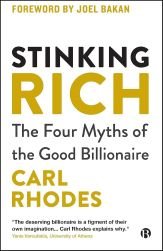
How do we break out of this loop, or better, throw it into reverse? What levers should we reach for? I began asking around to see who could educate me. A friend and an ex-Professor at UTS, Stephen Wearing, answered point blank: Carl Rhodes! Carl is the mind to reach out to! I Googled. I bought and read Carl’s most recent popular book Stinking Rich: The Four Myths of The Good Billionaire and found it full of wisdom. It is deeply researched and an easy read and I thoroughly recommend it. I reached out. Carl said yes. We met in his office in the distinctive Gehry-designed building that houses the business school in Ultimo, Sydney, and had a wonderful conversation, during which he helped me understand more about the system that got us into this mess and – more importantly – how we might get out of it.
You can listen to the conversation on “FutureBites With Dr Bruce McCabe” via Spotify or Apple or wherever you get your podcasts, or by clicking the play button below. I’ve also included a full transcript at the end of this post.
Carl started by explaining that billionaires at the pointy end of the system served as a useful way of talking about the culture and the politics of inequality more broadly; his point was not attacking billionaires per se. His point was understanding an underlying system that is broadening and getting worse, what perpetuates it, and what can be done to make it fairer. Everything I write about neoliberalism is in the same vein. Named billionaires demonstrate the stakes. US examples are most illustrative because it’s the most powerful democracy assailed by the most blatant threats with the biggest global consequences, but as Carl made clear, the inequalities and exchanges of wealth for power are infecting the political landscapes of the UK, Australia, and many other countries.
Still, billionaires represent a danger all of their own.
THE WRONG-HEADEDNESS OF ASKING BILLIONAIRES FOR SOLUTIONS
Carl made me reflect more deeply on the wrong-headedness of asking those at the top of the wealth pyramid to dismantle the foundations they stand on. The contradiction should be obvious, but this is exactly what we are doing. Not only tolerating it, perpetuating it.
I’ve met countless Americans, rich and poor, who have explained to me with almost Messianic fervour how Elon Musk is a genius and therefore the one who will ‘get us out of this mess.’ Travelling through 44 US states before, during, and in-between Trump administrations and asking his supporters everywhere to help me understand the attraction, I heard the same answers again and again: “Because he’s a businessman.” “Because he knows how to make money and he’ll run this country like a business.” An African-American lady pushing eighty and still driving an uber to put food on the table gave me that same answer, and this after sharing how proud she was to have marched for equality and economic justice alongside Dr Martin Luther King! Behind this thinking lay two deeply-held convictions: (1) politicians suck and a businessman is not a politician; and (2) a businessman will reduce waste and cut overspending on overbloated social ‘programs’ thereby making government more efficient and reducing taxes and getting the economy moving and raising the general level of prosperity for all. When I gently asked if a businessman running a country might not also view them in cold ROI terms as exploitable assets or costs to be cut, they invariably shook their heads in bafflement.
Citizens at the bottom of the wealth pyramid burn with injustice and yearn for better, and one of the places they look for ‘better’ is the rich maverick businessman (as Carl points out, it is almost always a man).
In reality, corporate- and billionaire- capture perpetuates costs on the bottom 99 percent, and I’m not just talking tax breaks for the rich. Current US energy policy, for example, is an aggressive rearguard action against the transition to renewables. This, at the behest of one uber-wealthy part of one industry (fossil fuels) and at the expense of all other industries and all US households which are already a half-decade behind the global leaders in accessing cheap energy, and much further behind in profiting from the global export boom in batteries and solar panels and electric vehicles (in all cases now led by China). Eliminating pollution controls is another example. Green-lighting uber-wealthy technology companies to inflict AI on the public without regulatory controls is another. It’s a long list.
Much of Carl’s work is about deconstructing the myths that allow people to think the exact opposite – that billionaires are altruistic, that they are skilled, that they have earned their place, that they are ‘self-made,’ that their philanthropy is democratic, that ‘meritocracies’ promote equality, that their wealth ‘trickles down’ and that they will help us. He strives to answer the cultural question of, as he puts it, “how billionaires get away with it and why we don’t instead see crowds of people with pitchforks running after them saying, This is not fair. This is not right. We need to change it.” There is a particularly delicious chapter in his book eviscerating the people who attend Davos. I cannot do the myths justice here; I strongly recommend you read them for yourself.
WEALTH-INEQUALITY AND LOST DEMOCRACY
Carl’s book, and our conversation, drew for me much brighter lines connecting the dots between wealth inequality and the efforts of billionaires to not only perpetuate neoliberalism, but to subvert the democratic institutions that threaten it, spiralling society towards, in Carl’s words, “power being wielded on the basis of how wealthy people are, rather than on the basis of an equal form of citizenship.”
Again, you might yell, ‘it was ever thus,’ but never has the danger been this great. Why? Because beyond the extreme wealth-for-influence power grab, our society is more information-centric than ever before, and billionaires are owning and dominating the key information channels like never before. How’s this for a starting list? Rupert Murdoch & family (News Corporation, Fox News, Wall Street Journal, New York Post); Elon Musk (X/Twitter); Jeff Bezos (Washington Post); Mark Zuckerberg (Facebook, Instagram, Threads, WhatsApp); Larry Page & Sergey Brin (Google, YouTube); Larry and David Ellison (Paramount/CBS, with more on the way) … Now go and look at the top 10 in the Forbes Billionaires List. People can only act based on the information they have. People vote according to who they believe is responsible for the fix they are in and who will get them out of it. Whoever controls this narrative wins. ‘Discourse rigging,’ is the term Carl uses in his book. Perhaps not all of these billionaires push their political agendas via their channels, but how would you know?
And it is getting much, much worse with AI. The lost agency to it. The deification of it. The same AIs owned and controlled by the uber-wealthy for the singular goal of making trillions, and parlaying those trillions for power to make more trillions – emissions rates and water shortages and electricity prices for the bottom 99 percent be damned. Every Internet search is preceded by an AI-generated ‘overview’ which is rapidly becoming the default, no need to click further. As an instrument of manipulation, it is already a hundredfold, soon to be a thousandfold more powerful than social media. As an instrument of perpetuating wealth inequality, it will perhaps be the worst ever. And a reminder, if you can bear me repeating this, the power of the AI you are experiencing now is nothing compared to what is coming.
CULTURE NOT POLICY HOLDS US BACK
So much for the problem. I came for solutions! What levers can we pull to start reversing wealth inequality and neoliberalism? It’s worth quoting Carl’s opening response in full [italics are mine]:
The levers are quite straightforward … you need to have mechanisms for redistribution of wealth through tax and transfer systems that can reduce inequality after the event, progressive taxation, welfare systems, universal basic income, so that there's a fairer distribution and [through] that everyone can live well. You can address it through policies around pre-distribution, which is about making sure the inequalities aren't created in the first place, by things like labor bargaining power, strength of trade unions, market rules, breaking up monopolistic and oligopolistic … creating more market competition. This is all within a capitalist framework. It's not a socialist argument, right? Changing institutional competition policy, housing policy. You can do it by creating more equal opportunities through education, providing universal childcare so parents can work, and more generally dealing with the unequal distribution of assets by moving towards wealth taxation systems over income taxation. So policies can do that. What's holding us back is politics and culture, not policy.
I might add to Carl’s list of policies, resource taxes and wealth redistribution back into the hands of all citizens (as they do in Alaska), political donor transparency laws, donation size limits, criminal offenses for politicians to lie during campaigns (as has just been enacted in law in Wales) and simple adjustments to de-incentivize residential homes as an ‘investment class’ thereby going a long way to restoring housing affordability.
Expanding on the culture holding us back, Carl said:
It's almost as if we don't want it yet. And any moves towards trying to make this change will be met with massive resistance, particularly through the media, because it goes against the interests of the wealthy people you mentioned before, who control much of that media … But also culturally, you'll get pushback of people who think this isn't fair because it will destroy meritocracy or it will destroy aspiration and ambition. So the barriers are political and cultural ... It's not for a shortage of ideas of what to do that's preventing us having a more equal society. It's that the cultural, political forces that want to maintain the current unequal status quo are extraordinarily strong.
I must confess to a sinking feeling as I listened to this, not because Carl isn’t right – he undoubtedly is – but because I guess in my heart I was hoping to hear something rather more direct, something quicker. I came for levers! But culture change? Ocean acidification and denuded fish stocks and accelerating forest fires know nothing of culture change!
But going back over previous interviews I find myself using the same language. This from me while discussing housing unaffordability with Professor Darinka Czischke: “Culturally, often, I come across this ingrained, societally taught notion that your house is an investment. Not a home, it's an investment. You know, one of its primary purposes is to generate more wealth. And that, to me, we need to break that somehow, because so often I see the behaviours following that.” Hmmm, not just the same but the exact same language.
What Carl made clearer is this: culture is not just a factor, it is the central factor; until the culture supporting neoliberalism changes, policies will not follow.
CHANGE VIA DEMOCRATIC ACTION
Carl advocates change via ‘pragmatic coalitions’ applying democratic principles, one step at a time.
He is talking about democratic action in its broadest sense. The ballot box. Protests. Community meetings. Joining a trade union. His book. Our conversation. Talking to a family member. This article. All are exercising our democratic rights. Personally, I feel the need to add economic forms of protest; fighting dollars by taking away their dollars. Politicians aided by partisan media have become adept at deflecting and downplaying street marches, and sociopathic billionaires simply don’t care what the public thinks about them. But when ordinary citizens band together and buy product B instead of product A to protest, the billionaires do change behaviours. The dollars count.
Carl suggests we must exercise our democratic rights in our everyday lives with what skills we have and what place we occupy. This connects with me – we can all do something – as does his admonition to think of democracy not as some perfect state of affairs but as an aspiration, “Kind of like a promise. You never actually achieve it, but you've got to try and keep that promise every day as best as you can.”
Still, it’s not exactly instant gratification is it? And it’s not exactly cause for optimism. We’ve already mentioned media domination. In the current US administration, billionaires are inside the tent writing and enacting policy. The Justice Department has been weaponized to attack political opponents and avenge disloyalty and intimidate journalists. The systems of collecting and counting votes have been attacked. Presidential pardons are issued on industrial scale. An intimidating armed federal force has been deployed on an apparently punitive basis into cities that are considered ‘uncooperative.’ An arms race of gerrymandering is under way. The highest court in the land, always partisan, is starting to look like a rubber-stamp. As I write, a Bill has been tabled for a $1.8 Billion slush fund which will apparently be used in part to ‘compensate’ political allies who stormed the Capitol trying to overturn an election.
Can a system so damaged still function well enough to repair itself? Will a new administration even bother? Rigged systems, after all, hold attractions for all sides.
In truth, I’m confident US citizens will repair their democracy. Every state is filled with people who exhibit immense capacity for generosity, kindness and sacrifice within their communities. I’ve stayed in their homes. I’ve caught 100-mile rides with them in their trucks and carved pumpkins with them in their kitchens and downed beers with them until all hours in their bars. They are as good a people as you will find anywhere in the world. They know community. The paradox between ground truth and toxic US politics is explicable to me only as layer-upon-layer of storytelling peddling an unattainable neoliberalist version of the American Dream and urging good people to fear ‘the other,’ and it feels to me that at least some of the first steps to healing – recognising rage-bait and toxic algorithms for what they are and knowing who perpetuates them and why – are underway. Hope too, can be found in the ousting of Hungary’s Victor Orban, an authoritarian populist kleptocrat who had made significant inroads in controlling the media discourse (on the other hand, Orban respected and accepted the election process).
The really concerning question for me is not ‘Will it be repaired?’ but ‘How long will it take?’ The social and ecological costs of delay are huge. As for breaking the culture of neoliberalism more broadly, now we’re talking decades. The toll will be monumental.
But what’s the alternative to Carl’s suggestion? Revolution? The more I try to come up with different pathways, the more I come back to his way of thinking. As he points out, progress towards wealth-equality never came from a caped crusader. More fundamentally, change must come via the majority to be legitimate and have any chance of enduring.
CHALLENGING DEEPER UNDERPINNINGS OF NEOLIBERALISM
I believe we will need to dig deeper into the cultural underpinnings of neoliberalism to make lasting change. Here are three additional things we might usefully strive for:
Recalibrating social norms for what constitutes ‘reasonable prosperity,’ as they seem to do so well in Scandinavian countries and as introduced to me in the corporate context more than a decade ago by a regional CEO of that truly remarkable Danish engineering giant, ARUP, which embodies strong social purpose and is owned by a trust which is run by and for the benefit of employees. Knowing reasonable prosperity makes unreasonable prosperity less acceptable.
Transitioning to more holistic measures for corporate accountingand replacing the woefully inadequate GDP as a national measure of success, as the UN recently attempted to do by adding wellbeing, equity and sustainability indicators (to lukewarm reception) and as Carl proposed by including wealth-disparity in Australian national indicators (And why not? Does it not connect directly with the maxim, ‘The measure of a society is how it treats its most vulnerable?’ It seems an excellent indicator of national progress to me). There may be a chicken and egg thing here, with national adoption required before business standards can follow. Business leaders have demonstrated, for example, they will only adopt carbon accounting in the fullest sense when mandated by governments or their biggest customers, and then only when applied equally to preserve a ‘level playing field’ with competitors.
Changing the psychology of ‘success’ by getting the middle classes back in touch with the true ‘happiness factors’ (relationships, security, meaning in work, contribution, trust, knowing your neighbours have your back) as backed by ample data and shared with me by John Helliwell, editor of the Global Happiness Report and as correlated with the most productive workplaces (those neoliberal ideals are still being fed!). I once got talking to a lady who was an assistant to a string of billionaires and when I asked her what they were like she answered, “Lonely and miserable. Each and every one,” and after a beat added, “Some people are so poor, all they have is money.” Brilliant. I should like that etched on my tombstone.
What do you think? Unrealistic? Kumbaya? On the podcast you’ll hear me ask Carl if some of these are hopelessly naive, and in truth I almost cringe when I say them aloud because of how ridiculously hard they are. But it seems to me to change neoliberalism we must also address some of these underlying social norms, or at least nudge them back in a sensible direction. If we don’t, all other fixes are temporary.
WHAT CAN WE DO AS INDIVIDUALS?
I’m still groping for better answers, using writing as a way to organize my thoughts. Of all the global challenges, neoliberalism seems the most intractable. I used to say it was sustainability, but without addressing neoliberalism how to achieve sustainability? Until more learning gives firmer direction, writing on the ‘right’ or ‘best’ pathways feels faintly ridiculous, but it also feels important to try.
There is hope.
Carl categorizes himself as a ‘hopeful pessimist,’ by which he means
If you are optimistic, that means you think everything's going to work out fine, so you don't have to do anything. If you're pessimistic that everything's going to work out bad, there's nothing you can do about it. But if you're pessimistic and hopeful, that means you think it's going in a bad direction and that's why I've got to do something about it. So pessimism is actually, can be, a political force because it can motivate ... Everything can change.
I like that very much. I like too, that he says he can feel that change coming, that when he reflects on the big changes in the 1980s that gave birth to the domination of neoliberalism, it feels like we are entering a time of equally significant discontent that power equally significant change. What kind of change, spread over what timeframe, embracing how many nations, he cannot predict. Neither can I. I’ve met some of the very best political analysts and they can’t predict either. But a big change? Yes, that feels about right.
And you and I can accelerate that change.
Paraphrasing Carl, now is the time to do what we can, with what talents we have, to halt the march towards plutocracy and reject the culture of neoliberalism fuelling it. At the very least we can take a few minutes here and there to bust through the myths of the ‘good’ billionaires that Carl writes so eloquently about, and educate ourselves to the costs and consequences. We can research and satisfy ourselves as to the merits of specific policies and vote accordingly. We can make ourselves available to our friends and colleagues when they ask for help to do the same. We may only be able to take small bites, but small bites add up.
Thank you again, Professor Rhodes, for generously sharing your insights.
FURTHER READING
Books and resources mentioned in our conversation:
Stinking Rich: The Four Myths of the Good Billionaire by Carl Rhodes. You can learn more about Professor Rhodes and find links to his other books on his profile page.
Our World In Data Income share of the richest 1% (before tax), 1910 to 2024
Oxfam International 2026 Global Inequality Report
Oxfam International report From Private Profit to Public Power: Financing Development, Not Oligarchy
Forbes World’s Billionaires List and 2026 World’s Billionaires List Facts And Figures
United Nations briefs and supporting documents for its proposed global dashboard to measure progress beyond GDP by adding wellbeing, equity and sustainability indicators to complement GDP.
World Happiness Report 2026 See also my interview with John Helliwell, Professor Emeritus at the University of British Columbia and editor of the World Happiness Report since its first edition in 2012.
Limitarianism by Ingrid Robeyns
As Gods Among Men: A History of the Rich in the West by Guido Alfani
Hopeful Pessimism by Mara van der Lugt
INTERVIEW TRANSCRIPT
Please note, my transcripts are AI-generated and lightly edited for clarity and will contain minor errors. The true record of the interview is always the audio version.
Bruce McCabe: Hello and welcome to FutureBites, where we explore pathways to a better future. I'm your host, Bruce McCabe, and my guest today to talk about billionaires and associated topics is Professor Carl Rhodes. Welcome to the podcast, Carl.
Carl Rhodes: Great to be on the podcast. Thanks for inviting me.
BM: Thanks for making so much time, and this is such an important discussion. I've been looking forward to it so much. And you came to my attention because I guess everybody in the world's getting very uncomfortable right now. I certainly am. And a bit more aware of the power and influence of a few billionaires on really big changes in global industry, society, life. We look at ownership of information systems and conduits to news, and direct influence on American politics has become very salient. So I really wanted to have this conversation because you wrote this wonderful book recently – and what a title to capture the zeitgeist – 'Stinking Rich: The Four Myths of the Good Billionaire,' the latest of a long line of books. So that's how we've come here today.
You explore in your work, as I understand it, really a triangle here. You're looking at business and society. You're a professor of business and society here at University of Technology Sydney, but you're looking at connections between business, wealth inequality, and also democracy. And sort of that triangle that I draw. Would that be an accurate way of describing you?
CR: Yeah, that's pretty accurate. And the book's about billionaires, but really that's also a way of more broadly talking about the culture and the politics of inequality. And the billionaires is this growing class of often highly visible, potentially even ostentatious figures. They just kind of represent the extremes, the pointy end of a system of inequality. So it's the broad system of inequality that I'm really concerned with. People sometimes say to me, "Carl, do you hate billionaires?" And I say, as individual people, I might have an opinion. I find Elon Musk quite an unpleasant character, but that's not the point. The point isn't about bringing it down to whether we do or don't like particular individuals. It's that they represent a system of inequality that is broadening and that's getting worse and is making life harder for more and more people in more and more different countries. So I think the focus has to be on what is that system and what perpetuates it and what can be done to make it more fair. And that idea of fairness as it links to equality, as it links to freedom is where the democracy angle comes in. So I think you've summed it up pretty right that it is therefore about this sphere that looks at democracy and equality.
BM: And they're certainly affecting both the trend towards inequality, which is very, very clear when we chart it over time, and also the individual billionaires who wield so much power at the pointy end of that inequality. They're certainly affecting our future. They're very much dictating a good portion of our future right now.
CR: Because in a way, when it gets to extreme wealth, it's not so much just about money. Like, if your income or my income doubled, our lives would change significantly. Well, I don't know, maybe you're a billionaire. I'm not. But if my income doubled, I'd move to a nicer house, probably. I'd probably get a nicer car. I'd certainly be drinking a higher quality glass of wine for dinner on a Friday night. It's Friday today. Now, if Elon Musk's currently worth somewhere around a trillion dollars, if his wealth doubles, his material life doesn't change in any way. He can't consume anymore. He can't live any better. At that level, it is actually about power. The money is actually about how much power you have and how that power can be exercised. And if you look, coming back to Musk, which is a frequent example in the book, if you look at the influence that he had on the US election when he was helping in the election campaign and putting a lot of his own money and gaining a lot of publicity and really kind of working that process, and then later using that with the work he did with the Department of Government Efficiency, which was a bit of a failure. But that is about how you leverage wealth for power and influence. So that's another thing that we're... And in that case, arguably quite a distortion of democracy. I don't know if you remember when the inauguration of Donald Trump in January of 2025, there's an area in the place where the inauguration happens which is normally reserved for foreign heads of state and dignitaries. And who was there? The tech billionaires. Elon himself and Mark Zuckerberg and I think Jeff Bezos was there and a few others. Again, symbolizing the kind of connection with extreme wealth and political power, which Trump is very happy to leverage unabashedly, without any... Shamelessly.
BM: Yeah. And it seems that the central thesis for a lot of what you've written here is that, and I can see it every day, but there's a sort of vicious circle here. You've got people amassing a lot of wealth, converting that to power because, as you say, they've got everything they need in life, and then the desire becomes influence to impose their own personal goals and values on the greater world. And we definitely see that sort of behavior. But then in imposing that power and also being given that power very willingly – which is something we need to explore – by the public who look to billionaires to solve some of their problems, they then usurp, bend, break democratic processes, certainly they go around the back of democratic processes to get things done. And so in the end, they perhaps end up damaging the machinery of democracy and often in a way that helps perpetuate even more wealth for themselves. It's like that sort of a circle. Is that a fair summary?
CR: Yeah, yeah, it is. I mean, if you think about inequality and billionaires, on the one hand, it's an economic issue and there's many economists who will study this and do great work in terms of looking at the mechanics of how it works and quantifying it. My approach is kind of in parallel to that, is to try and look at this from a cultural perspective. It's like, how do they get away with it? Why, where are the crowds of people with pitchforks running after them saying, "This is not fair. This is not right. We need to change it"? When, so to try and look for a cultural explanation of how they get away with it. And part of that is because there's a kind of whole mythologization of billionaires as somehow being, they deserve it, they're somehow extremely smart and meritorious. For many people, they're role models. How many young people in startup businesses dream of being the next Elon Musk or Jeff Bezos or whoever it might be.
But even more culturally, if you remember last year, Jeff Bezos got married in Venice. He practically closed down the whole town as he's swanning around in a gondola with this massively ostentatious show of wealth that then gets paraded across the world's media as look, look at these great people, the masters of the universe. And somehow almost with a view to say to people, "You could be like this, too." But of course, and maybe a handful of people will be like that in the future, but for the majority of people, that's not possible. And in fact, for the majority of people, even more moderate expectations of a comfortable life become more and more difficult. I mean, even in developed countries like where we are here in Australia, wealth inequality is broadening so widely, and we have our own growing cadre of billionaires as well representing that, as the middle class is getting hollowed out and we're moving more and more to a kind of society of haves and have-nots. But at the same time, there's a whole lot of forces there saying the way things are are good, right, and fair, and anything else is not. You've seen it this year here as we've been in debates in the media around changes around tax reform that came through in the budget. And various people saying, "Oh, if we change these taxes that make housing more affordable for young people and shift tax burden away from wages to wealth earning, that the sky's gonna fall in and everything's gonna be destroyed." And it's just catastrophizing at an extreme level. So again, there's so much trying to reinforce the system we have. And I think my work, in a kind of modest way, is part of trying to resist that.
BM: And try and break down those myths around the billionaires. That's one that comes up so much in my work. I'm constantly encountering very influential business people around the world and government people in the Middle East, in Asia, everywhere, who assign someone like Elon Musk some special set of capabilities because he's good at amassing wealth, because he's obviously succeeded in that department. Somehow he must be wise in other departments too. And I never see the connection or why they should see that, but certainly in America it's more salient. But yeah, the myth of the somehow more capable person in other departments is immense.
CR: Leadership scholars call this the Great Man Theory, bearing in mind that it is a very... I use the word "man" deliberately. It is a very masculine image of greatness. And this is a theory which has zero... There's no evidence to support it, in fact, quite the contrary. But there was still a kind of idea, and it's been around for hundreds of years, that there are some people who are greater than the average people, and it is they and they alone who can take leadership positions and create great things or lead nations or these days, businesses to places they otherwise couldn't go. You saw it last year when the Tesla board of directors was justifying the extraordinary payout that put Elon Musk on his way to being a trillionaire. And if you read the board papers, which are public, they specifically just say, Elon is the only person who can do this. Without Elon, Tesla will not go anywhere. And you think this is such a...
BM: It's a god complex, though.
CR: No, it is.
BM: It's a deification.
CR: I know, but he's not the guy who designed the cars. He's not the person who goes out selling them. He's not the person who works on the factory floor putting them together. Anything great that's produced is produced by a whole bunch of people working together, but it just gets concentrated in this one person. And that's part of one of the myths that these billionaires are somehow better than everyone else, as you say, at everything, even potentially morally superior. And you often hear people of this nature really stepping out of their lane and kind of promoting particular views of the future of humanity. When Musk took over Twitter, now X, a few years ago, he wasn't just buying a company to make money. It was all about... What did he call himself? A freedom of speech fundamentalist or something of that nature. It was about he was going to restore democracy through technology.
BM: Yeah, he was until it inconvenienced him.
CR: Yeah, exactly, exactly. But this is the kind of rhetoric of such greatness, and it needs to be undermined because it's so damaging. Because as all that kind of floats above trying to push us to think that these are great people leading us to a bold new future, underneath, economic inequality is literally killing people.
BM: Yeah. Another one like this would be Bill Gates. I spent so much time looking at energy solutions and technologies around the world, and I've traveled firsthand to see them, and then I've looked at some of the things he's invested in, and I think he must be surrounded by yes-men and women who just won't contradict him, because he's invested in things that I could have in 10 minutes saved him $100 million on investment. They're just not, absolutely not, gonna go anywhere. But yet, he's seen, because he was good at developing a computer business, as someone that must therefore deeply understand the potential of some of these technologies to save on emissions or climate or produce more cleaner energy. And he has … It's incredible, that sort of extension of capability people have in their psychology.
CR: In many ways, Bill Gates was the prototype for the current batch of Zuckerberg, Bezos, Musk kind of billionaires, and kind of at the forefront of the growth of the tech industry over previous decades. But absolutely. I mean, didn't he... I can't remember which order it was, but he released a book, I think the first one was on how to solve the climate change. And he had this whole thing about that he, with zero qualifications or experience in this field, had the answer. And it was only about a year later he released a book about how we can, what we need to do to make sure we never have another pandemic.
BM: Yeah.
CR: I mean, the fact that someone had the nerve to think they could answer one of those questions, but to answer two within the course of a couple of years, I mean, the arrogance is astounding.
BM: And it seems self-perpetuating because I don't think people around them will challenge them. There's a sycophancy, if you like, perhaps just to be … the proximity to the money, I'm not sure how it works. But clearly they're not hearing dissenting voices nearly enough to bring them down to earth, or they're not tolerating them.
CR: But Gates is an interesting example because now he comes across as a kind of Cashmere jumper wearing, kind of uncle figure in many ways. But if you read the stories about his behavior when he was head of Microsoft, the stories are of very aggressive or bullying type of management. When the company was young, apparently he used to walk around the car park at 6 o'clock to see who was still at work, and if you left early, then maybe you're in trouble. And people used to go to meetings and play a game, they'd count the F-words to see how many times he said the F-word in meetings as a gauge of his mood because he was constantly swearing. There was a time where someone was suggesting introducing diversity initiatives into Microsoft and he went crazy saying, "You're not gonna ruin my company with this effing F whatever." Not an exact quote. So he did have that reputation as a very aggressive, bullying kind of character then. You don't see those stories now. I mean, there's also other stories about his personal life, but clearly not a man lacking in self-confidence.
BM: Yeah. So let me bring you back to this connection into democracy. To me, it seems like the most dangerous part of all of this. That the power that comes from the wealth and then the connection to power, the support, the dependency of people who look to billionaires or give them the reins to power, is leading to them influencing the entire democratic system, and funding changes to it or attempts to change it. And in the US particularly, I think that's salient at the moment, we can see that. So how dangerous is this moment? How much danger are we in of, say, losing the structures of democracy altogether with wealth inequality?
CR: I think it's very much a real and present danger. I think the US system is probably the most extreme, but it exists elsewhere in the world, certainly here in Australia. And this kind of trend towards oligarchy, so the trend to power being wielded on the basis of how wealthy people are rather than on the basis of an equal form of citizenship, which is a formation of democracy. If you look at people who do hold power, it's directly correlated to wealth. People who hold political power more commonly come from wealth, as well as the direct influence of power that we certainly see in an extreme level in the US. But also here in Australia, you've seen Clive Palmer's somewhat ham-fisted attempts at politicking. You've seen recently Gina Rinehart, Australia's richest person, giving an airplane to Pauline Hanson from the populist One Nation party. So you're seeing it here as well. We have more guardrails around the system legally than they have in the US that are kind of protecting things, but the trend is the same. And bear in mind, Gina Rinehart, well-known supporter of Trump, hangs out in Mar-a-Lago from time to time, I believe calls herself one of the Trumpettes.
BM: Yeah, so she's an internationalization of... There's almost some level of coordination in there. I remember something even worse than giving away airplanes is when she didn't like what a particular newspaper was saying, so she bought a controlling interest in the newspaper. And we saw Bezos do that with the Washington Post as well.
CR: I know.
BM: That I find even more pernicious.
CR: Yeah, yeah.
BM: And dangerous. You add the Murdoch empire as a whole and the amount of control over so many news channels, that to me seems exceptionally dangerous. And that's even before we get into AI and their control over the mechanisms for artificial intelligence.
CR: Yeah, and influence and also, of course, control over social media platforms. Again, Elon Musk's purchase of Twitter can only really be seen as a kind of political choice as much as an economic one. And so control over the media by billionaires and by wealthy people is particularly worrying because the media and the free press, the fourth pillar, it's a central dimension of democracy. And the idea democratically is that the media and journalism in particular is there to hold power accountable, to speak truth to power. But if the media is owned by people who are powerful, how can it perform that function? And that we see as very dangerous. And it's interesting, you often hear more reactionary types complain that the media is all left-wing bias and we never hear anything because the left controls the media. Look around. I mean, maybe there are some parts of the media that have a left-wing perspective, but it's not happening in much of it, particularly the Murdoch kind of press here, Sky News, or in the US, Fox News. It's directly influenced and often, and there's money behind that too.
BM: Of course there is. And unfortunately, the machine exists to make money, and money is made through rage, anger, perpetuating certain issues. I love the phrase you used in your book, it's just a lovely summary of that: Discourse rigging. Just came across that. But to me, it's whoever controls the narrative wins the election. And it doesn't matter how good the people are, if they're being told the same consistent story about the world and how fearful they need to be of crime, immigrants, failure, whatever the enemy might happen to be, if they're all getting that same story, they'll all vote the same way. And when you can control the channels of information, that to me seems exceptionally dangerous. And I've had a lot of conversations on this podcast with people about the controlling of AI. There's a deification process with AI as well. People ascribe to AI capabilities well beyond what it's actually doing, and it's just a natural tendency. But there's people behind that. Elon's openly talked about his willingness to change, to make sure we make it more ‘right,’ his particular AIs.
CR: I know. It's... But I used to be a big user of Twitter, and I really miss the old Twitter because it was a place which I engaged with. It was a source where I became aware of news and I became aware of debates. It's a place where a lot of people I knew, whether they be actual people I know as friends or just people I knew from broader society and politics that I wanted to keep up to date with. It performed, for me, that kind of work. And then it wasn't long after it became X that suddenly, well, first of all, I seemed to get so many of Elon's personal posts directed to me. Now, no algorithm influenced by my choices was doing that. And then for some reason, I don't know if it was how the algorithm worked, but if it kind of realized, it thought about something because of my demographics, but I was getting a lot of videos of street fights.
Now, I don't know. I've never searched for a street fight in my life. I have zero interest in seeing people punch each other on the street. But all of a sudden, I was getting this influx of videos of street fighting. And so like many other people, I've stopped using it because it became... It just became... There was something controlling it. I mean, I know that there was control before that, but it was something that I could kind of understand what it was doing and I was happy to participate in it. But that level of control... I mean, maybe these street fights were supposed to try to distract me from my political concerns or something. I don't know.
BM: Make you angry and afraid. The toxicity.
CR: I know.
BM: So, yeah, I've stopped using it as well for all the same reasons a long time ago. So let's turn to the hard part. This is where we're only solving potentially the world's biggest and most challenging problem.
CR: Yes.
BM: But to me it is... We're really talking about a shift in philosophy since the '80s, right? Neoliberalism, this very distinctive moment when Thatcher and Reagan and others stood up and basically the world said the markets should decide, governments should get out of the way, we should let the economics decide everything. And suddenly, this unfettered economics and capitalism, well, in a great whoosh over the last few decades, has become more and more dominant. Now, I sort of came to this from different directions. I came from an ecological destruction perspective. When we look at consumerism, we look at emissions and pollution controls disappearing in the US, for example, federally, driven by money. So I'm seeing wealth inequality and neoliberalism as driving huge ecological problems, a significant driver of some of the world's biggest problems. And I think socially we agree the same thing. So it's big. What levers can we pull to start reversing that?
>>>NOW
CR: Yeah, because I mean, the thing is, the levers are quite straightforward, to be honest with you. I think the mechanisms to change it are quite simple. You need to have mechanisms for redistribution of wealth through tax and transfer systems that can reduce inequality after the event, progressive taxation, welfare systems, universal basic income, so that there's a fairer distribution and that everyone can live well. You can address it through policies around pre-distribution, which is about making sure the inequalities aren't created in the first place, by things like labor bargaining power, strength of trade unions, market rules, breaking up monopolistic and oligopolistic... Creating more market competition. This is all within a capitalist framework. It's not a socialist argument, right? Changing institutional competition policy, housing policy. You can do it by creating more equal opportunities through education, providing universal childcare so parents can work, and more generally dealing with the unequal distribution of assets by moving towards wealth taxation systems over income taxation. So policies can do that. What's holding us back is politics and culture, not policy. The political system... How do you get to a stage where those things can be implemented because of the massive resistance there will be to it politically?
So it's almost as if we don't want it yet. And any moves towards trying to make this change will be met with massive resistance, particularly through the media, because it goes against the interests of the wealthy people you mentioned before, who control much of that media. So you see small changes like you've seen with the budget here get a massive backlash of fairly uninformed and outrageous arguments designed to distract and push things back. But also culturally, you'll get pushback of people who think this isn't fair because it will destroy meritocracy or it will destroy aspiration and ambition. So the barriers are political and cultural. How to do it is there...
BM: They're big barriers, though.
CR: They're huge barriers. But it's not for a shortage of ideas of what to do that's preventing us having a more equal society. It's that the cultural, political forces that want to maintain the current unequal status quo are extraordinarily strong. And again, my book is a small way of trying to undermine some of that.
BM: Yeah, I guess the individual listening to this feels very removed from the levers of change. We're a couple of steps removed. We get to vote. We get to put in, hopefully, a representative that might represent some of those interests. But now you're already fighting with different interests in the media and that sort of thing. And hopefully, you get enough of those representatives into a parliament or a congress to effect change. And they're fighting to vote in a system where the information flows are fighting them. So grassroots democracy, we talk about that, but is that ultimately what this is about? We have to refine and get back in touch with actually local campaigning?
CR: I think it is. And I think it's about exercising our democratic rights, not just at the ballot box, but every day. You and me having this conversation. You contacted me and said, "Would you like to talk about this?" and I said, "Yes." And so we are doing democracy now by having this conversation, as might be people who are listening to it who then go and talk to people. So I think it's about realizing that voting is part of democracy, obviously, and having democratic representatives, but it's also a part of our everyday lives. And if each of us can participate in that in ways that are within our power, now that might be going to meetings in your local community, it might be joining a trade union, it might be... I'm an academic. What do I know how to do? Research, teach, and write. They're my three skills.
BM: Yes.
CR: So those are the things I do.
BM: Within your domain of expertise.
CR: Yeah, within my domain of expertise and within a role that I legitimately have to be able to do that. And all of us in different ways have different positions that we can work from. Again, a lot of that is working within the community and families that we're a part of. So it's important that we exercise democracy every day in some way, if it's not just having a conversation with somebody.
BM: It's really, I think you point out in your book, it's literally the definition of democracy. It's power of the people. And we're moving towards this plutocracy, is that the right term?
CR: Yeah.
BM: And... So if we were to prioritize one thing above all else, I guess it's restoring or fighting to protect in any way we can anything that's trying to erode those levers of democracy. Would that be fair? And using them, because they're under threat. So are many other things. But if we could get that back so the power of ordinary non-wealthy people is properly representative, it hopefully flows through to a better world.
CR: That's how democracy works. And democracy's never... Democracy, I think it's important not to think of it as a kind of state of affairs. Democracy is always an aspiration. It's better to think of democracy as kind of like a promise. You never actually achieve it, but you've got to try and keep that promise every day as best as you can. Or another metaphor, you can think of democracy as like a horizon. Like if you're walking to the horizon, it's because you see that as a worthwhile goal. You never actually get there because it keeps moving away. But it's about the movement towards something, hopefully trying to achieve something better for the world, better for people, whether it be political, whether it be economic, or in the examples you've been using, whether it be ecological and environmental. But how do we continue to try and pursue this idea that we might progress to something better as a human race, no matter how hopeless that might seem at times, still trying to keep that promise.
BM: What about other ways of exercising bottom-up power? And one in particular would be the bottom-up economic power, buying power. So I remember when people stopped buying Teslas around the world, and it must have had an effect. And I often think the way, certainly the way someone like Elon acts sometimes is almost psychopathic. He doesn't really care what people think of him or about others, but he certainly cares about his money.
CR: Yes.
BM: And so when people stop buying them, it has an effect. Now, not everyone can stop or is in a position to, but I've seen consumer boycotts work really, really well at a smaller scale and completely change a political decision because companies are hurting and they lobby the politicians they own accordingly. What do you think? Is that a legitimate pathway here?
CR: Yeah, I mean, I think it can be a legitimate pathway. I don't think it's a kind of answer to the whole thing. It could be potentially part of that answer. But certainly, the behavior of consumers towards brands can make a big difference. And if you're hurting businesses in the bottom line, they will respond one way or another. So it is possible that that might be. Remember years ago when they were bombing in... French were bombing in Moruroa, and then people were boycotting whole products?
BM: Yes. And South Africa and apartheid as well.
CR: Yeah. So it can, it certainly can have an effect. But political process... It's not a substitute, I don't think, for a broader political process either. And as well, hopefully gaining movements don't just have to be within one country. They can be much broader than that naturally. And we saw that with the Wall Street Movement...
BM: Occupy Wallstreet.
CR: Occupy Wall Street after the GFC. In a sense, that kind of failed because capitalism and neoliberalism came back even stronger. But on the other hand, what was happening then, going back some years now, right, 15 years or so. And remember they had the slogan, "We are the 99%." That was when the beginning of economic inequality getting back on the political agenda, which since the '80s, since Margaret Thatcher and Ronald Reagan's time you mentioned, had pretty much been off. It was all about growth, growth, growth, and distribution was just not considered. So even these kind of global political movements can also make a big difference. And we saw a number of them at that time. There was the MeToo movement, for example, the Black Lives Matter movement, really raising political awareness, I mean, also raising quite a lot of backlash. But these are also ways that people, you can see in recent times, participating in democracy as a part of daily life, not just once every three or four years or however frequently your election is.
BM: What about … I'm gonna throw more of these at you just to explore that. What about independent, more independent politicians? I look at the US, I've traveled to pretty much every state, and before the first Trump presidency, I couldn't believe how much support I was hearing. And I traveled through 42 states asking the same question, why? Why do you like him? And the answer was very clear. There was two things they said. "He's a businessman, he'll run this place like a business." Now, I'm saying I'm not sure you want it run like a business, but the other one was they really hated what they had. They hated all politicians. They felt that they were not properly represented by the political class, if you like. And I got that from Democrats and Republicans across the board. Democrats almost universally that I spoke to did not like Hillary Clinton. They wanted something better to represent their party. Now, how do we get that representation?
CR: I know, and this is a feature of liberal democracies around the world. And I would actually say much of the reason that we have the populist problem now isn't because of the actions on the political right, it's because of a failure on the political left. And through this neoliberal era, we saw a relative alignment around kind of this globalized economy, free market type of approach, and political differences were more about social and cultural issues. A lot of discussions about questions of identity politics and kind of culture war issues, and politics was divided on these things. Now, those are important debates, I'm not suggesting they weren't. But core questions of economy were stripped out of a left-wing agenda. And so what that also then meant is that you had a significant portion of working people and to some extent unemployed people who were largely not represented by either side of politics.
BM: Yes.
CR: In fact, not only they weren't represented, they were dismissed. When Hillary Clinton talked about the "basket full of deplorables," this is the people. So you have the people who are suffering economically, who are on the wrong side of inequality, were no longer, as left-wing parties became middle-class parties, not working-class parties anymore. And it kind of created a new group, a fairly large group of disenfranchised people.
Many of those are the people who voted for Trump. So the hollowing out of the middle class and the creation of a disenfranchised working class leads the way to populism. And to some extent, the US was a forerunner of that. You saw similar things in the UK. We're about 10 years anniversary of Brexit now, and now they're in a state where Nigel Farage and Reform looking like they have a real chance of getting into Downing Street.
BM: You think UK citizens feel unrepresented by both sides?
CR: Yes.
BM: Completely?
CR: Yes. And frankly, they're right. They're not represented by either side. And so what happens then is someone comes in claiming to represent their interests, and that's obviously politically attractive, whereas they don't really represent their interests.
BM: No. And one of the straws they grasp for is that maybe a businessman or a billionaire will … they'll be different and they'll help us.
CR: Yeah.
BM: And so you end up with that as well.
CR: Yeah, which is, that's not really how business works. Business is about taking money from people.
BM: I always remember that movie 'The Corporation,' which I loved in 2003. The corporation is a psychopath and it doesn't care about people. It's a machine.
CR: Yeah. Joel Bakan, he's a... I know him actually. He's a professor at the University of Toronto, professor of law. Yeah, the idea that if the legal personhood which corporations have legally, what kind of person would it be? And it matches the psychological definition of being a psychopath.
BM: Yeah. So just this idea of independence, though. So we've got these two, we get these monolithic parties, and often just two of them, who cannot possibly represent everyone's interests when they start turning into monoliths. And then we saw something of a breakup of that in this country, we're sitting now, in Australia, in the last federal election here, with a bunch of climate and capitalist-focused independents. They're very focused on the combination that energy change is a money-making enterprise and we can do that well and we save money at the same time. Now, that seems to produce something healthier to an extent. Certainly, the discourse is much more varied now.
CR: Yeah.
BM: Is that the direction? We need to break down some of these? I mean, I guess you can't dictate direction here. You get what you get.
CR: But that is what is happening here. And to some extent in the UK. Or in the UK, it seems to be the ruling Labor Party that's disintegrating, where here it was the opposition right-wing Liberal, center-right Liberal Party that's disintegrating. But yeah, there's been a kind of, for countries like the UK and Australia and the US, there has been a system, pretty much through the 20th century, certainly post-World War II 20th century, of there being political differences, but it being largely revolving around a two-party system. And that with neoliberalism, the two sides of those parties coming closer and closer and closer together, and that's been the kind of norm. And that is falling apart now. And it's falling apart through right-wing populism growth, through alternatives from independent politicians who come from different spheres, less so in Australia, but in other countries also the growth of left-wing populism. My view is that if you go back to the '80s... I'm 59 years old, so I was a teenager for most of the '80s, so it was a kind of formative time, so I remember that. And that was a big time of change, the birth of the domination of neoliberalism. I think now we are at a time of equally significant change. It's just that because we're in it, we don't really know where it's going, as we didn't know then where it was going, as we know that in retrospect.
BM: But you can feel the discontent.
CR: Yes, I feel exactly the way I felt then in terms of the period of change. And then the discontent was with stagflation and lack of economic growth and opportunities, and the idea that this is what Thatcher called popular capitalism and her adoption of the economic views of Friedrich Hayek and Milton Friedman would suddenly liberate the world. And Ronald Reagan said that trickle-down economics. And none of that actually worked, but it created a massive influence. And I think we're at a similar state of flux now. But why we might see some of the trends that are happening now and the direction, it's not really possible to know exactly what it is because we're still swimming in it, waving our arms trying to stay afloat, and we don't know exactly where that current's going.
BM: So in the last 40 years, are there any countries that have pushed back and reversed this direction towards neoliberalism?
CR: I think everyone's been caught up to some extent because mainly through effects of globalization and countries compelled to engage in global trade and then the freeing up of global markets and countries tended to generally get swept up around that. But it's been adopted differently in different countries. You certainly see a different version in the Scandinavian countries and the whole idea of what some people call Nordic capitalism, which is much more of a welfare state-based capitalism. And where countries like the UK set fire to the welfare state under Thatcher and kind of destroyed trade unionism, that was less the case in Scandinavian countries and to some extent Central European countries, Germany would be an example as well. So I think it's been adopted differently. It was even adopted differently here. I mean, the first round of neoliberal reforms here were implemented by the Hawke-Keating government, Labor government. But that was where, when everyone else was privatizing, what did we do? We introduced the universal healthcare system of Medicare. So Australia's been different. I mean, the hard neoliberal changes here were made relatively late under the Howard government. So, yeah, different countries, but I don't think there's any country that's truly been able to resist it. Even if you look at China and China's entry into the global market, now, you wouldn't call China a neoliberal country by any means, but you can't say that it hasn't been influenced by global neoliberalism.
BM: They've certainly taken what they want out of it and it's been an incredible success. One of the people I've had on this podcast, an energy analyst, Michael Barnard, has made a hobby of collecting headlines from The Economist magazine of people who write about why the Chinese economy is about to fail. Right? But he's got hundreds of them over the years in a spreadsheet and it's just wonderful because everyone sort of says it can't work, but they've managed to make their version work.
CR: But it's a different approach. You've got many people now worried that AI is going to lead to massive job losses and you're already seeing organizations restructuring around this line. The Chinese government have outlawed it. You're not allowed to sack people because of AI. And so, that's not a democratic approach, but it's a different kind of approach, but same pressure's being responded to differently.
BM: I never dismiss any of them. It's always … there's always another way and it's always interesting to look at them and learn from them. Yeah. Wow. Okay. So one of the things that as we look at sort of this time of discontent that I wonder, I hope it's not true, but I sort of in the back of my mind is, do we need things to get catastrophic before people really, really take a different approach to the governments they elect? And for me, again, it's ecological. The inability to get house insurance in parts of the US because of the storm damage and all the coastal issues and that's climate change and tornadoes and all the rest. You can map the frequency of that. Maybe that has to get bad enough, or maybe people have to get so poor that they literally are taking to the streets in a whole different motivated fashion that...
CR: Although in the US that's happening. One of the last trips in the US I was in San Francisco, one of the … a wealthy place, just kind of at the down the road from Silicon Valley where the tech billionaires...
BM: It’s got both ends there.
CR: I know. And there's like people living in shantytowns.
BM: Thousands and thousands.
CR: And that's not homelessness caused by, you often get homelessness as it's related to questions of mental illness and...
BM: Sure. Or addiction or alcoholism.
CR: But this is just people who've fallen through the safety net and families living in these places. Someone's telling me they were walking past one of these shantytowns in Los Angeles and you see kids coming out with backpacks going to school. So that's the worst example. And then you have people who are on the other side of the inequality divide living in gated communities to keep the fear of the hordes out. I mean, what kind of life is that?
BM: I know. How extreme does it have to get, though, before there's some sort of, uh, political uprising, anyway? Yes, it's I go there all the time and it's noticeably worse. It's just you it's visual, very visual. There are whole parts of Oakland and University of California at Berkeley just near there, just street after street after street of homeless encampments. And they weren't there when you go back a little ways. So it's very disturbing.
So let me throw some rather different ones at you just as we come to a close. And they might be hopelessly naive, so tell me if they are.
CR: Nothing wrong with naivete. It can be quite useful.
BM: [laughter] I think back to someone we had on the podcast, John Helliwell. He's the editor of the Global Happiness Report, which is mind-blowingly good. It's so interesting what makes people truly happy in different countries. And community, of course, is a huge part of this. But basically, as I reflect on the findings of that kind of research, can we change the psychology of success? Can we target what people consider wealth and success? Because it’s obviously not monetary. True success and happiness comes from relationships, from meaningful work, having meaning in your life and in your work, trust in the community you live in – a huge part of those sorts of findings – or this notion of ‘reasonable prosperity’ in terms of money. Security comes first and then not accumulating vast amounts of wealth. Do you think there's any hope of changing the trajectory of the psychology of success?
CR: I think it's always important to retain hope. I'll be even more naive and say that what about a situation where success comes from how much you contribute to other people ...
BM: Beautiful.
CR: And not just be... Part of neoliberalism is individualism. It's all about me and everything's about my benefit and my wealth. It's almost like we've made a virtue out of selfishness or we've made a virtue out of greed. That's a a comment from the subject of an essay in the '70s by Ayn Rand. And to reverse those kind of values. I think that would be tremendously difficult, but absolutely desirable.
And I think it's interesting you use the word hope because I've been thinking a lot about hope recently, and there's a great book called 'Hopeful Pessimism.' And the idea is that if you are optimistic, that means you think everything's gonna work out fine, so you don't have to do anything. If you're pessimistic, that everything's gonna work out bad, there's nothing you can do about it. But if you're pessimistic and hopeful, that means you think it's going in a bad direction and that's why I've gotta do something about it. So pessimism is actually, can be a political force because it can motivate to try and make things different. So it's important to have, I wouldn't say naive, but perhaps idealistic kind of views of a future as a way of motivating political action. So around these things, can that change? Everything can change.
BM: One thing that gives me hope with this aspect of the conversation is we're sitting in a business school. You're a professor of business and society in a business school at a major Australian university. And so your students are obviously hearing much more nuanced messages about contribution and relationship to society than just ‘how to run a good business.’ So that's some hope there, isn't there? It's an educational process.
CR: And there are a number of, I mean, and that's not just me. This is part of what has been our general approach here at the business school to try and offer people a broader sense of business education. On the one hand, we don't want accountants graduating who can't read balance sheets. Not saying that, we need to be able to do that, but not just that, to also have a broader appreciation of the role and purpose of business and society. And there is quite something of a movement towards that direction, not in all business schools, but in many, and certainly amongst many individual kind of academics and teachers and professors, that's very much alive and present. So yeah, the stereotypes don't always hold when it comes to business schools.
BM: Yeah. It might not be a five-year transition, but maybe a 50-year one, but it's all contributing to it.
CR: Well, it's taken us that long to get into this mess, so it's probably gonna take us that long to get out if that's the direction we go.
BM: Do you think we can recalibrate even social norms about – I guess it's the same question – but what is reasonable prosperity? Because massive wealth accumulation is gross. It does affect a lot of people. They see, so just recalibrating what a level of, it's one thing to amass a couple of million dollars, it's quite another to amass a billion and sit on it and not share it.
CR: But this is the question about inequality. If we accept a liberal democratic system where you have a society and a politics that aspires to democracy and you have an economy that's market-driven and capitalist, it's not to say that you want a totally equal system, which would be a kind of communist utopia or in those terms where everyone, I think Marx says, "From each according to his ability, to each according to their needs." That's not the idea. Within a market-based economy, you will have inequality. Because the idea is that people might aspire to have a better life for themselves and their family is what does provide aspiration and does provide a kind of incentive in a way to get ahead and be productive and lead to economic growth. So the question isn't about whether there should be any inequality. The question is how much. How much inequality is healthy in order to maintain the balance between democracy and capitalism? And I think we can debate a long time as to what the right amount of inequality should be. But whatever it is, it's hard to justify that it should be where it is now and the direction that it's going in now. So often you get into micro debates around should we have this policy or should we have that policy. But what about the bigger question is what would a fair society look like? And on that basis, how do we try to get there? Because a fair society isn't, as I said, it's not about total equality. It's about choosing a level of inequality that allows everyone in society to still get on and to still live good lives. So it's not like a competition between the rich and the poor.
BM: One more naive one. You mentioned accounting.
CR: Yes.
BM: The global accounting standard for national success has been economic growth, GDP specifically, which is obviously a very poor measure because it's so crude. Recently, the UN tried to broaden that very significantly with a whole matrix of measures. I think their issue was they couldn't get everyone to agree. But how realistic is it that we can progressively add more to that balance sheet and make it truly reflective of business impacts on society and ecology?
CR: That's a tough one because GDP has been so dominant. I mean, even the idea of having inequality measures. I actually did put this proposal forward last year in an article I wrote for The Conversation saying that if Australia is serious about inequality, then it should have targets for inequality the same way we have targets for other things …
BM: Why not?
CR: … Zero traction! [laughter]. Maybe not zero, but not much. So I think we've got to still... So I think, I mean, on the one hand, coming up with kind of happiness indices is a way. And our treasurer Jim Chalmers did consider that, I think, some years ago, but then I think got caught up in the realpolitik perhaps.
BM: A field trip to Bhutan perhaps is in order.
CR: But even having a basic thing like adding a goal for inequality, there's a number of ways that that can be measured, would be quite straightforward things to do. But the obsession with economic growth above all else, irrespective of who benefits from it. It's like the thing if we live in a society, it's just you and me and you have a million dollars and I have zero. The headline is average wealth half a million, whatever it is, I've lost my number, half a million. Yeah, that's irrelevant, right? The fact that I'm hungry and you're living a great life. But that's what happens because it's just the total and the average that gets considered. So even at that basic level, considering economic distribution as a political goal could make a big difference even before getting into the harder metrics around happiness and so forth.
BM: Well, we're coming to an end. I'm gonna give your book a bit of a plug just to finish this. But before we do, and the reason is I love it, I love what you've written there. But before we do, just where should people go to connect more with understanding the processes around neoliberalism, the wealth disparity, and its effect on democracy? Are there particular places you direct people, resources to go further into this?
CR: Oxfam always produce some great reports. It's worth having a look at what Oxfam are doing.
BM: Specifically on inequality, right? They measure it.
CR: Yeah. Specifically on inequality, as well as a range of other things, particularly on a global level. There's a number of resources you'll find through the UN. There's a number of good books around that you could read.
BM: You've named a couple.
CR: Yeah. Ingrid Robeyns' 'Limitarianism,' where she suggests putting a wealth cap on wealth. Guido Alfani released a book recently called 'Gods Among Men' looking at the history of inequality. So there's plenty there to read and look, both in terms of books and on the web. But also, you find a lot just watching movies and the cultural and the arts are also dealing with these issues. So you just need to be a bit more open to, if you're not aware of these things, they're not hiding. They're not hiding from you.
BM: Well, everyone listening to this, you couldn't do better than starting with Professor Rhodes' latest book, and it's 'Stinking Rich: The Four Myths of the Good Billionaire.' I don't normally sort of out-and-out plug books on this, but I want to pull that one out because it's such a work of scholarship. It's good storytelling as well. And if you start there, it does reference so much in terms of other scholarly work, other research, other inequality research, points you in lots of directions. And it's connecting, even though the title's focused on the billionaire, it connects into the deeper issues and the history of neoliberalism and some of the mechanisms. It's a fantastic primer. And to me, as I said at the beginning of this or early in our conversation, it seems to be a causal factor, at least behind most of our challenges in 2026. So it's really something I'd recommend everyone take a look at. Are you a, what did you call it, a hopeful pessimist?
CR: Yes, absolutely.
BM: So am I.
CR: That's another book worth reading. I can't remember the name of the author off the top of my head, but 'Hopeful Pessimism' is worth a read. But yes, I absolutely am. And the thing is, you see things that strike that chord of injustice, and that is what should spark political action of some kind, whatever it is that we're able to do.
BM: Professor Carl Rhodes, thank you so much for the conversation today.
CR: Look, my pleasure. Really great talking to you.
Cover image of the Capitol in Washington DC credit: Krisztian Kormos, via Pexels