
BIOFUELS IN AVIATION AND SHIPPING 2050
What percentage of fossil-based, high-emissions fuels used in ships and aircraft will be replaced by biofuels in 2050?
By Bruce McCabe
June 26, 2026

The future use of biofuels in shipping and aviation matters because aviation accounts for approximately 2.5 percent of greenhouse emissions (and because they occur high in the atmosphere, their contribution to global warming is 3.5 to 4 percent) and international shipping accounts for another 2 percent. And while electrification will make important in-roads in both sectors, the vast majority of all marine and aviation traffic will still be dependent on fuels by 2050.
Additionally, aviation and shipping industry bodies frequently make bold statements about future adoption of biofuels, such as the International Airlines Group saying it “expects to use Sustainable Aviation Fuels for 70% of total fuel in 2050.”[i] Many of these statements appear to make little consideration of supply limits, especially the limits of producing biofuels without actually increasing emissions. Almost all discuss one sector without consideration of the other. To make sensible decisions about the future it is important to analyse both sectors, as well as make consideration for some continued demand in the automotive sector, because in the context of biofuels, all have a common problem and will be competing over the same supplies.
RULING OUT E-FUELS
Before getting to biofuels, let’s briefly deal with electrofuels or ‘e-fuels’ – any of the alcohol and hydrocarbon-based fuels such as e-kerosene, e-methanol, e-diesel, e-methane, e-ammonia much hyped in the popular media, that can be manufactured by using electrical energy to combine hydrogen, carbon dioxide and other ingredients. Any close examination reveals them to be hopelessly unattractive. We’ve already encountered the crippling clean electricity input requirements for manufacturing clean hydrogen. All e-fuel trials suffer from the same industry sleight of hand, where tiny experimental volumes today, usually incorporating some emissions-intensive element in the process, come with a whispered promise to ‘clean up’ and scale-up ten-thousand-fold at some unspecified and uncosted time in future. They won’t. Splitting and making bonds between atoms takes a lot of energy. You can’t beat the physics. If they try, the energy inputs and costs will be sky-high, and they will increase future emissions by drawing huge allocations of green electricity away from applications that have much higher carbon-reduction potential. E-ammonia, much discussed in recent years as a potential maritime replacement fuel, carries the additional nastiness of being exceptionally toxic and unsafe to handle near water. People who have spent their careers on ships tell me fuelling their vessels on ammonia would be bonkers. Attempting to re-engineer vessels and ports with sufficiently safe plumbing would jack up high costs even higher.
E-fuels can be safely dismissed from playing any significant role in the future of shipping and aircraft through 2050.
FIRST-GENERATION BIOFUELS
The biofuels that are most familiar to us are made by growing crops then processing them into ethanol products, almost all of which go into gasoline blends for road vehicles. Like e-fuels, they are built on a conveniently one-sided myth, which in this case goes something like this: crops sequester carbon, so when you burn them you are back where you started – “net-zero.” The myth ignores all emissions during growing, harvesting, transportation and processing, as well as the emissions consequences of deforestation and the broader ecological consequences (acidification, eutrophication, water footprint and biodiversity loss) of using arable lands to grow fuel instead of food. The progressive electrification of harvesters and trucks and processing plants will reduce those specific emissions, but not otherwise. Total emissions from biofuels production involving deforestation are higher than burning fossil petrol. New land allocations are currently associated with deforestation in tropical areas. When tropical deforestation is involved, emissions from palm oil-based biodiesel can be a multiple of emissions from burning fossil diesel.[ii] For all these reasons ‘first-generation’ biofuels using crops as feedstock are regarded as a very poor use of arable land. Over 90 percent of biofuels worldwide come from first-generation crops today, and those crops currently occupy a land area roughly the size of Germany.[iii]
Nevertheless, for the purposes of answering our question, the lands already producing first-generation feedstocks for automotive biofuels are considered a source that could potentially be ‘re-purposed’ to supply feedstocks for aviation and shipping without increasing emissions, if no further deforestation is involved.
SECOND-GENERATION BIOFUELS
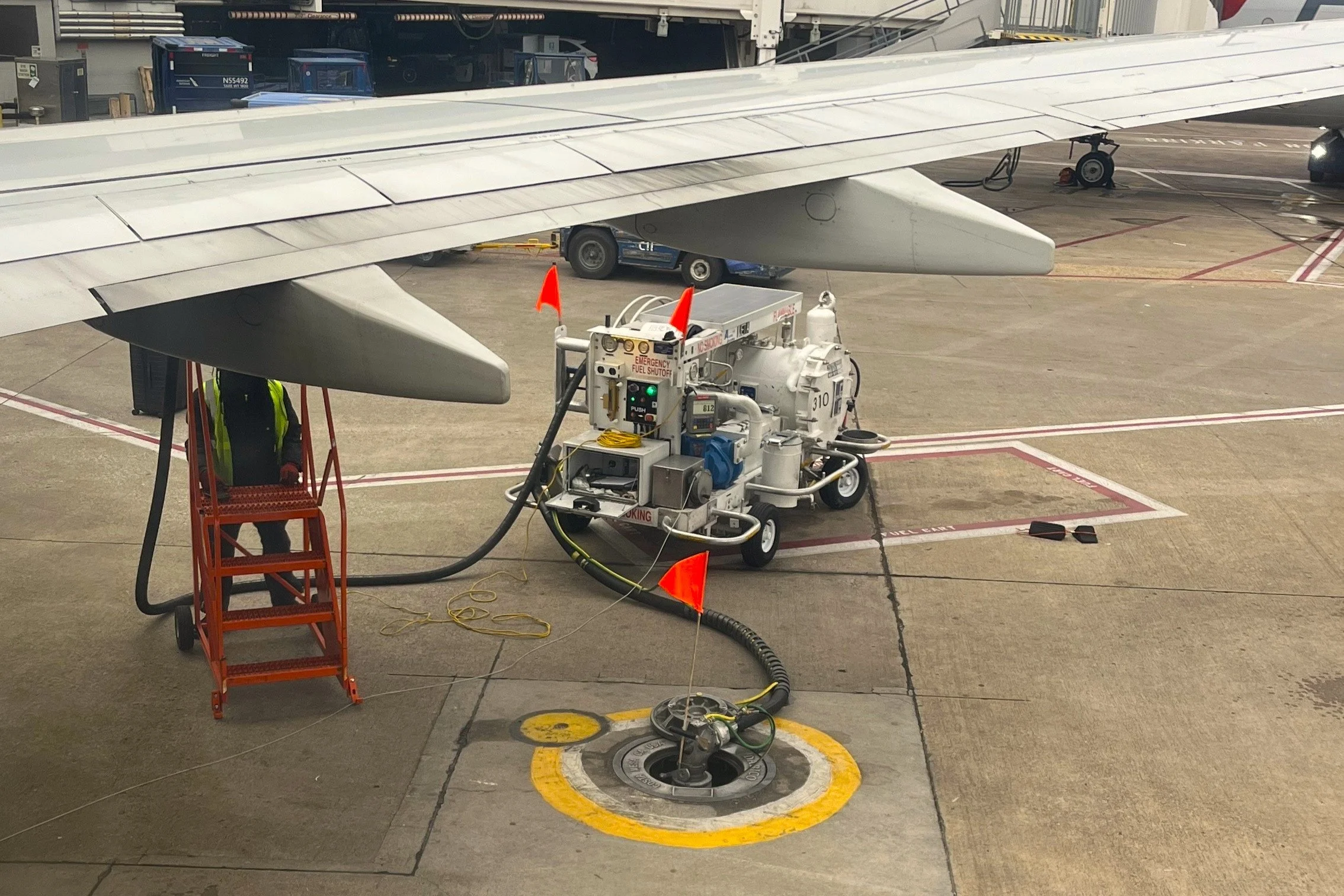
So-called ‘second-generation’ biofuels take in as feedstock waste biomaterials such as used cooking oils collected from restaurant kitchens, waste animal fats, husks collected during harvesting, food waste, and forestry residues. This goes a long way to taking care of the land-use problem and can reduce emissions by as much 80 percent compared to fossil fuels. The costs are significantly higher than refining fossil fuels because there is no getting away from the additional collecting and processing overheads.
Used cooking oil (UCO) is the dominant feedstock for second-generation biofuels. It is energy-dense, it is relatively easier to collect and process, there appears to be plenty of it, and collection rates in some countries are already high. The second most important second-generation feedstock is waste animal fat. It has similar energy-density advantages and can be collected from renderers that receive and process the by-products of slaughterhouses and meat/poultry processing plants. Bio-diesels and Sustainable Aviation Fuels manufactured from these feedstocks can substitute for bunker fuels in ships and kerosene-based jet fuels in airliners (with modifications).
Other second-generation feedstocks are associated with a steep slide in diminishing returns. Spoiled harvests, unsold crops and inedible plant materials collected during harvesting (husks, sugar cane waste, etc) are available in high volumes but have lower energy densities and much higher processing costs, and much of what is considered ‘waste’ in this context is not waste in agricultural and ecological terms where it is better utilized as animal feed or to release valuable nutrients back into the soil. Further, the reduction of food waste at the farm, via better market matching and supply-chain coordination, represents a significant opposing economic opportunity. Forestry residues, while available in high volume, are among the worst second-generation feedstocks due to low energy density and high processing costs. Burning wood and sawdust and leaves, in processed or unprocessed form, is an insanely inefficient way to power motorized vehicles. Food wastes collected at the other end of the supply chain (peelings, scraps, dumped due to supermarket spoilage, sludges, coffee grounds) have low energy density and processing costs compounded by the added challenge of separation from other kinds of waste. For these reasons, all of the above sources add up to a tiny percentage of feedstocks used in biofuels today.
Second-generation biofuels made from UCO and waste animal fat feedstocks are prima facie the ‘lowest friction’ preferred pathway for low-emissions fuel alternatives in shipping and aviation through 2050.
THE TROUBLE WITH ALGAE
Growing and harvesting oils from microalgae in a continuous cycle from ponds is much lauded as a possible ‘third-generation’ biofuel feedstock. Unfortunately, it has failed to deliver because the ponds required are large, aquaculture at scale creates its own ecological challenges and – mostly – because yields are much too low. Low yields per hectare, plus high energy inputs in cultivation, harvesting and drying combine to produce higher life cycle emissions than burning fossil diesel.[ii]
In recent years many projects have been abandoned, and the research focus of surviving projects has switched to genetically modifying wild strains of algae to hopefully produce (much) higher yields of lipids.
This reminds me of a time back in 2012 when I got excited by a company called Joule Unlimited, which put genetically-engineered photosynthetic bacteria into tanks that resembled green-tinted solar panels, nourished them on a combination of carbon dioxide, sunlight and water, and waited for the bacteria to excrete ethanol and biodiesel as byproduct of photosynthesis. Their future vision was essentially hooking up a series of these tanks to a factory smokestack at one end and collecting biodiesel from a tap at the other end, to pour directly into the tractor – no harvesting, transportation or bothersome chemical plant to worry about. Joule Unlimited shut down in 2017. All similar startups that I noted down at the time are gone. Every scientist I’ve raised this with since has dismissed the method as too expensive and producing too little yield.
I’m not saying it cannot be done – I’ve already witnessed first-hand astonishing enhancements in genetically-engineered crops – but I consider scalable, commercially competitive outcomes improbable enough to be safely ruled out of a forecast for aviation and shipping through 2050.

HOW MUCH COULD WE SUPPLY WITHOUT INCREASING EMISSIONS?
UCO
Global edible oil production in 2023 was 223 million tonnes. That same year approximately 34 million tonnes of used cooking oil were collected, which tells us that about 15 percent of freshly grown and harvested oil ends up being collected as used cooking oil. There are competing markets for UCO and about one third of it, 11 million tonnes, ended up in chemicals, industrial lubricants and animal feed. Approximately two thirds of what was collected, 23 million tonnes, found its way into biofuel production, almost all of which ended up on motor vehicles. [iv][v]
The collection rate could be improved, but by how much? An examination of the supply-chain helps us estimate a ceiling. Approximately 68 percent of UCO is collected from restaurant kitchens, 22 percent from households and 10 percent from industrial food processors. With increased payment incentives (in many geographies restaurants pay for collection to meet their regulatory obligations, which incentivises dumping) applied across smaller kitchens and more households across more geographies, the collection rate might reasonably double. That is to say, 30 percent of freshly grown and harvested oil could end up being collected as used cooking oil. Perhaps it might be tripled to 45 percent, but I don’t think so. Much oil is imbedded in food, consumed, or lost to other destinations. Plus, it’s a rising cost curve. Double seems to me a more realistic stretch goal. The supply volume available would thus be 2 x 34 = 68 million tonnes.
From this we must subtract the existing allocations to chemicals, industrial lubricants and animal feed. Presumably these markets will grow, but in the interests of generating a ceiling let’s assume they do not. 68 million tonnes minus 11 million tonnes leaves 57 million tonnes.
The electrification of ground vehicle populations will not be complete by 2050 and presumably those markets will still want some allocations for biodiesel. Let’s assume automotive biofuels demand falls by 70 percent by 2050, and 100 percent of additional feedstocks are allocated to aviation and shipping, the supply volume available to shipping and aviation will then be 57 million tonnes less 6.8 million tonnes (0.99 x 0.3 x 23 million = 6.8 million) to leave 50.2 million tonnes.
If we convert 50.2 million tonnes [1 kg contains approx. 37 MJ energy] into barrels of oil equivalent to make a like-for-like comparison, it comes to 309 million barrels of oil equivalent.
ANIMAL FATS
We can estimate a similar ceiling for animal fats. The best data I can find on animal fats are from conference proceedings of The European Fat Processors and Renderers Association, which place global waste fat used in biofuels at 4.1 million tonnes, representing one-third of total production from renderers worldwide (12.2 million tonnes) in 2023.[vi][vii]
I have been unable to locate data on total fats produced by meat processors to help calculate a proportion collected by renderers, but there a lot of competing markets for these valuable by-products and my working assumption is that most slaughterhouses and poultry processors already supply renderers and loss/dumping rates are low. Further, there must be a significant but unknowable proportion of double-counting for collected animal fats that are subsequently used in cooking and collected again in UCO. A doubling of global collection rates for animal fats by 2050 therefore may be over-generous, but in the interests of generating a maximum ceiling let’s assume it’s possible. The total feedstock supply volume available would thus be 2 x 12.3 = 24.6 million tonnes.
Once again assuming all other markets for animal fats remain static, and the entirely of new supply is allocated to airlines and shipping, 24.6 million less 8.2 million leaves 16.4 million tonnes.
Using our previous assumptions for ground vehicles, we must subtract 1.2 million tonnes for automotive (0.99 x 0.3 x 4.1 million = 1.2) leaving 15.2 million tonnes. If we convert that into barrels of oil equivalent (1 kg contains approx. 48 MJ of energy) it comes to approximately 123 million barrels of oil equivalent.
TRANSITIONING FIRST-GENERATION FEEDSTOCKS
Crops grown for ethanol probably do not offer a one-for-one mapping for crops ideally suited to marine and aviation biofuels, but in the interests of generating a ceiling, I will assume land requirements to produce a given amount of energy are roughly similar. Total liquid biofuels production, all forms, came to 836 million barrels of oil equivalent in 2024,[viii] 90 percent of this came from first-generation crops, and 99 percent of those outputs went into road transport.[iii] Applying our previous automotive assumptions, the amount that could theoretically be ‘freed-up’ and reallocated to aviation and shipping without increasing net emissions (because ‘the emissions price has already been paid’) would be 0.90 x 0.99 x 0.70 x 836 million barrels = 521 million barrels of oil equivalent.
WHAT MUST BE EXCLUDED
1.5 billion more people will likely use more cooking oil and animal fats in 2050. Assuming dietary patterns don’t change, this could theoretically boost UCO and fat collection totals by an extra 12 million tonnes. While feedstocks would still be double-used, this addition must be excluded on the basis that it involves increased land-use and deforestation, and therefore increased emissions. Global sustainability goals for food and agriculture are aligned in the opposite direction, i.e. reducing oil crops and especially meat consumption.
Similarly, I exclude new supplies from illicitly added lands for growing oil crops, although doubtless this practice will continue to be widespread.
The possibility of raising more animals to collect fat for biofuels can be ignored, because the multiples of land required to grow feed for livestock (as compared to simply growing crops) render this completely insane. No one would ever farm animals for fuel.
In all cases, the fundamental challenge remains land use. Double-use of cooking oil is “better,” but we cannot pretend that used cooking oil does not come originally from palm, soybean, rapeseed and sunflower growers, and we cannot pretend that sourcing sustainably produced feedstock in one part of the world will not see forests cut down for palm oil plantations in another. Markets and prices are interconnected.
PRICE IMPACTS
UCO- and fat-derived biofuels for shipping and aviation are more expensive to make than fossil fuels, and there is no getting away from the massively larger land areas and longer timescales required to grow feedstock compared to pumping fossil oil out of the ground. Today, Sustainable Aviation Fuel costs 2.1 times more, on average, on a joule-for-joule basis.[ix] For marine biodiesel compared to bunker fuel, the premium is also more than double.[x] This is likely the main underlying reason why SAF accounted for only 0.3 percent of global jet fuel, and biofuels accounted for only 0.2-0.3 percent of shipping energy consumption, in 2024.[xi][xii]
Supply constraints will likely more than offset any improved production efficiencies, keeping prices as high through 2050.
I expect carbon pricing mechanisms to increase significantly across all geographies between now and 2050, which will narrow the price gap by increasing the price of fossil fuels. When and how steeply, is unknowable.
Since fuel is 25 percent of the operational cost of airlines, doubling the price would increase the cost of airfares and air-freight airfares by roughly 25 percent.[xiii] Since fuel is approximately 50 percent of the operational cost of vessels, doubling the price would increase the cost of freight by roughly 50 percent. Those end-user price increases, however, are based on 100 percent replacement of fossil fuels with biofuels. In reality, end-user price increases will be proportional to the amount of fuel substituted by biofuels, and therefore lower.
Research suggests that corporate customer and logistics services providers will accommodate significant price premiums for more sustainable long-range flights.[xiv] Per capita leisure travel rates will likely fall, but totals will be offset by population growth. Jacking up sea-freight costs for goods and foods is a much, much bigger deal than jacking up international airfares. It will produce inflationary effects, realignments of local versus imported foods, alterations to retail supply chains, and so on.[xv] There will be strong pushback.
AVIATION AND SHIPPING FUEL DEMAND 2050
Aviation currently consumes about 7.7 million barrels of oil each day and shipping consumes about 4.2 million barrels each day, which comes to a combined annual total of 4,343 million barrels [xvi][xvii]
I am bullish about the eventual electrification and hybridization of sub-500 km range aviation routes, but in aviation terms – with long lead times on design and testing, long certification times, and long aircraft life, the 24 years between now and 2050 is a short timespan.[xviii] Further, while sub-500 km routes account for more than one quarter of scheduled commercial flights they only account for 5.2 percent of fuel burned, and flights of 4,000 km or more account for 5.1 percent of flights and 39.0 percent of fuel burned.[xix] Even one-hundred percent hybridization of short-range commercial aviation, assuming hybrid flights burn on average 40 percent less fuel, would only reduce total aviation fuel demand by a little over 2 percent.
Factors reducing marine fuel-energy demand include significant electrification of short-sea and inland shipping, improved design efficiencies, wider adoption of ‘slow-steaming’ practices, and the stunning fact that 40 percent of all ships are for the singular purpose of transporting fossil fuels, most of which is currently for motor vehicles and power stations which are steeply transitioning off fossil fuels.[xvii]
Regulatory requirements and carbon pricing will drive the biggest changes in demand for both sectors. Between now and 2050, climate consequences will escalate steeply and will increase public acceptance of carbon pricing.
Against all these is the bulldozer of a projected population increase of 1.5 billion coupled with affluence-driven rising per capita demand.
Relatively speaking, the supply ceilings are the most certain part of this analysis, while the biggest uncertainties lie in demand, especially the incentivizing effects of new carbon regulations.
My modelled forecast for 2050 is for aviation fuel-energy demand to be higher and shipping demand lower, with a combined fuel-energy demand in the order of 4 percent higher, at 4,532 million barrels.
HOW MUCH DEMAND COULD WE COVER WITH BIOFUELS IN 2050?
What percentage of fossil-based, high-emissions fuels used in ships and aircraft could be replaced by biofuels in 2050?
Based on these assumptions …
Automotive electrification is sufficient to ‘release’ 70 percent of current automotive biofuels production by 2050, and all of this volume is reallocated to shipping and aviation, and
Collection rates for UCO and animal fats are doubled, and
All other markets for these valuable feedstocks remain static, and
All additional second-generation biofuel production is allocated to shipping and aviation, and
Biofuel production is not allowed to increase emissions via additional land-use change and deforestation, and
Combined shipping and aviation fuel-energy demand is 4 percent higher in 2050
… my maximum biofuels supply ceiling comes to 309 + 123 + 521 = 953 million barrels of oil equivalent, or 21.3 percent of a combined shipping and aviation fuel-energy demand of 4,532 barrels.
Assuming that second-generation biofuels reduce emissions by 80 percent on average, and that first-generation biofuels with no land-use change reduce emissions by 50 percent on average, then biofuels could reduce emissions for shipping and aviation by a maximum of 13.4 percent in 2050, or 9.6 percent lower than present levels.
MY MOST PROBABLE FUTURE
Based on historic behaviors, airlines and shipping companies will only transition as fast as they are forced to. No transitions will take place for ecological or ‘good citizenship’ reasons. Unlike electric vehicles, the economic and environmental incentives are not aligned. Supply will remain tightly constrained, keeping prices high. Regulatory-mandated targets and significant increases in carbon pricing will be the main drivers of adoption, and the main regulators of fuel-energy demand.
Airlines and shipping companies will continue to preference blending over substitution, and will exhaust available supply of all ‘lower friction’ UCO and fat-based biofuels, and supply of first-generation biofuels, after which they will push vigorously for continued burning of fossil fuel products (bunker oil, methanol, etc) over paying multiples for biofuels derived from other feedstocks. I do not see regulators forcing them to do otherwise.
Since farmers and farming corporations select crops based on how much they can earn, not the ideal distribution of calories, and since we already tolerate high levels of ecological destruction masked by greenwashing, I expect a proportion of rising demand to be met by additional deforestation, with all the attendant ecological and emissions consequences that implies. There will continue to be much obfuscation and ‘gaming the system’ by growers and corporations, and indeed governments. It is easy to conceive a 2050 where biofuels are claimed to account for a higher percentage, but at a cost in increased emissions.
Overall, I expect biofuels to supply 19 - 21 percent of total fuel-energy demand for aviation and shipping in 2050, and contribute less than a 10 percent of emissions reduction over present levels.
Note that this is my ‘most probable’ future, not our ‘best possible’ future, and definitely not our ‘locked-in’ future. We can change it. I strongly encourage you to substitute your own assumptions and build on my analysis in whatever way helps you make better decisions. We can all make positive contributions by educating ourselves on the true costs of carbon, supporting carbon pricing mechanisms that act broadly to reduce emissions, challenging ourselves to reduce our personal transportation footprint (reduced air-miles, delivery miles, buying local) and by choosing lower emissions alternatives when available.
***
All of my futurism builds on the generosity of scientists and experts who share their insights with me. In this case I would like to particularly acknowledge the contribution of Michael Barnard, who inspired me to think much more deeply about supply of second-generation feedstocks in our wide-ranging conversation in January 2024. All of the mistakes (and there are always mistakes – we are talking about the future!) are mine.
Corrections, improved logic and pointers to better data are welcomed. This article is shared with the objective of soliciting critical review. A final version will be posted shortly.
Should you prefer to receive your futurism via inspired in-person storytelling, that’s my mission. Reach out, and let’s discuss a keynote or executive workshop tailored to the opportunities in your world.
REFERENCES
[i] “Sustainable Aviation Fuel.” Accessed June 15, 2026. https://www.iairgroup.com/sustainability/sustainable-aviation-fuel/.
[ii] Jeswani, Harish K., Andrew Chilvers, and Adisa Azapagic. “Environmental Sustainability of Biofuels: A Review.” Proceedings of the Royal Society A: Mathematical, Physical and Engineering Sciences 476, no. 2243 (2020): 20200351. https://doi.org/10.1098/rspa.2020.0351.
[iii] Ritchie, Hannah, and Pablo Rosado. “Bioenergy and Biofuels.” Our World in Data, January 12, 2026. https://ourworldindata.org/bioenergy-biofuels.
[iv] “Used Cooking Oil (UCO) Market Size & Share Trends, 2033.” Accessed June 15, 2026. https://www.marketreportsworld.com/market-reports/used-cooking-oil-uco-market-14719076.
[v] Our World in Data. “Vegetable Oil Production.” Accessed June 15, 2026. https://ourworldindata.org/grapher/vegetable-oil-production.
[vi] OFI. “Rise of Animal Fats in Biofuels.” Oil & Fats International, no. September/October 2024 (n.d.): 18–22. https://www.ofimagazine.com/content-images/news/Rendering.Biofuels.pdf
[vii] Prykhodko, Veronika. “Key Takeaways from the EFPRA Congress: European Animal by-Products Volumes up 7% y-o-y and Local Consumption Increases.” Fastmarkets, June 2, 2026. https://www.fastmarkets.com/insights/key-takeaways-from-the-efpra-congress-european-animal-by-products-volumes-up-7-y-o-y-and-local-consumption-increases/.
[viii] “2025 Energy Institute Statistical Review of World Energy.” The Energy Institute. Accessed: Jun. 17, 2026. https://www.energyinst.org/statistical-review/home
[ix] Scott, D’Errah. “Why and How to Bring down the Cost of SAF.” International Council on Clean Transportation, October 6, 2025. https://theicct.org/why-and-how-to-bring-down-the-cost-of-saf-sept25/.
[x] Lloyd’s List. “In Search of Price-Feasible ‘Alternative’ Marine Fuel.” August 29, 2022. https://www.lloydslist.com/LL1142012/In-search-of-price-feasible-alternative-marine-fuel.
[xi] “Disappointingly Slow Growth in SAF Production.” Accessed June 15, 2026. https://www.iata.org/en/pressroom/2024-releases/2024-12-10-03/.
[xii] Sekkesaeter, Oyvind. “Biofuels in Shipping.” IEA Bioenergy TCP ExCo96 Workshop, November 19, 2025. https://www.ieabioenergy.com/wp-content/uploads/2025/11/25_1119_03_DNV_Sekkesaeter_IEA-Bioenergy-TCP-ExCo96-Biofuels-in-shipping.pdf.
[xiii] Brueckner, Jan K., Matthew E. Kahn, and Jerry Nickelsburg. “How Do Airlines Cut Fuel Usage, Reducing Their Carbon Emissions?” Economics of Transportation 38 (June 2024): 100358. https://doi.org/10.1016/j.ecotra.2024.100358.
[xiv] “Unraveling Willingness to Pay for Sustainable Aviation Fuel.” RMI, n.d. Accessed June 18, 2026. https://rmi.org/resources/unraveling-willingness-to-pay-for-sustainable-aviation-fuel/.
[xv] Carrière-Swallow, Yan, Pragyan Deb, Davide Furceri, Daniel Jiménez, and Jonathan D. Ostry. “Shipping Costs and Inflation.” Journal of International Money and Finance 130 (February 2023): 102771. https://doi.org/10.1016/j.jimonfin.2022.102771.
[xvi] IEA. “Oil Market Report - August 2025 – Analysis.” August 13, 2025. https://www.iea.org/reports/oil-market-report-august-2025.
[xvii] IEA. “How the Shipping Sector Could Save on Energy Costs – Analysis.” March 2025. Accessed: Jun. 15 2026. https://www.iea.org/commentaries/how-the-shipping-sector-could-save-on-energy-costs.
[xviii] “Exploring Aircraft Lifespans and Retirement Decisions.” Accessed June 18, 2026. https://blog.sourceonespares.com/exploring-aircraft-lifespans-and-retirement-decisions.
[xix] Dobruszkes, Frédéric, Giulio Mattioli, and Enzo Gozzoli. “The Elephant in the Room: Long-Haul Air Services and Climate Change.” Journal of Transport Geography 121 (December 2024): 104022. https://doi.org/10.1016/j.jtrangeo.2024.104022.
First, fourth and fifth image credits respectively:- Haydn https://unsplash.com/@hgpound William https://unsplash.com/@william07 and Sebastian https://unsplash.com/@gsebastian ; all other images by the author.